
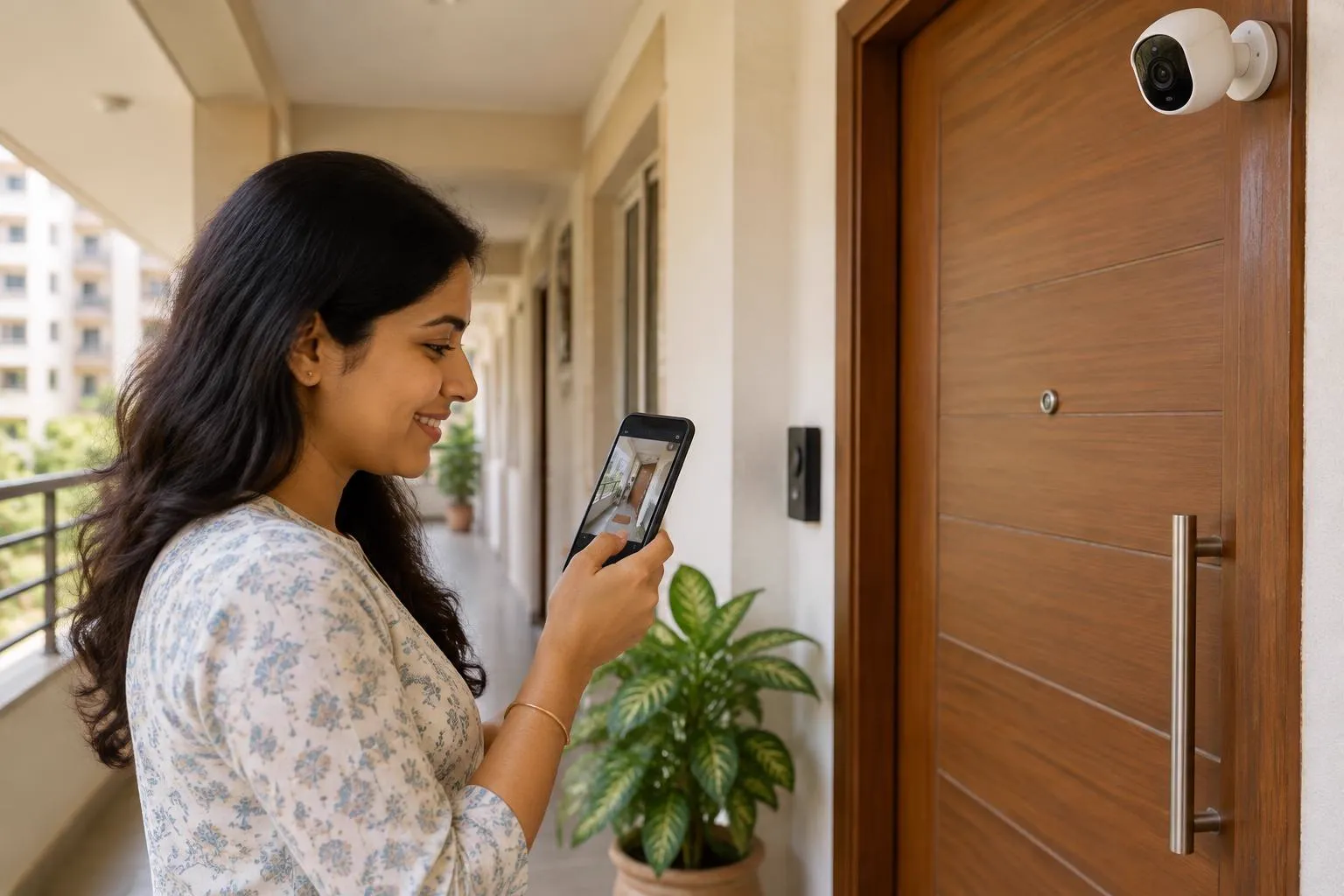
CCTV full form
CCTV stands for Closed-Circuit Television.
It is called "closed-circuit" because the video signal travels through a private, closed path — from the camera to your recorder and monitor — instead of being broadcast openly like regular television. Only people connected to that circuit can see the footage.
What is CCTV, in one sentence?
A CCTV system is a set of cameras that record video of your home, shop or office onto a local recorder (or memory card), which you can watch live or play back later — including on your phone from anywhere.
The parts of a CCTV system (and their full forms)
When you shop for cameras you will hear a lot of abbreviations. Here they are decoded:
- DVR — Digital Video Recorder. The box that records footage from traditional HD/analogue cameras connected by coaxial cable.
- NVR — Network Video Recorder. The recorder for IP cameras, which send video over network cable (Cat5e/Cat6).
- IP camera — Internet Protocol camera. A camera that sends video as data over a network; usually higher quality and easier to expand.
- PoE — Power over Ethernet. One network cable carries both power and video to the camera — no separate power wire needed.
- PTZ — Pan-Tilt-Zoom. A motorised camera you can rotate and zoom remotely.
- IR — Infrared. The invisible light cameras use to see in the dark.
- MP — Megapixel. Camera resolution: 2MP ≈ 1080p Full HD, 4MP and 8MP (4K) are sharper.
How does CCTV work? (The 30-second version)
- The camera captures video.
- Video travels through cable or Wi-Fi to the recorder.
- The DVR/NVR compresses and stores it on a hard disk.
- You watch on a monitor or, through the internet, on your phone app.
- When the disk fills up, the oldest footage is automatically overwritten — so yes, CCTV footage does get deleted automatically unless you save it.
Is CCTV legal at home and in shops?
Yes, broadly. You can record your own premises — your shop floor, entrance, parking and boundary. Two sensible rules:
- Don't point cameras into a neighbour's home or private spaces.
- In workplaces, inform staff that cameras are present.
India's new Digital Personal Data Protection (DPDP) Rules, notified in November 2025, are phasing in stricter duties for anyone handling personal data — including video of people — over an 18-month timeline (PIB, November 2025). For a home or small shop the basics stay simple: record your own property, keep footage secure, and don't share it casually.
Also worth knowing: the government has made security testing mandatory for CCTV equipment, with hundreds of certified models already listed (PIB, March 2026) — one more reason to buy established brands and change default passwords.
Common questions people ask next
How do I know if a CCTV camera is on or off? Most cameras show a small LED; dome cameras often don't. The reliable check: open the live view on the monitor or phone app.
Does CCTV record audio? Only cameras with a built-in microphone do. Many budget cameras are video-only — check the spec sheet for "audio" or a mic icon.
Can CCTV work without electricity? No — but a small UPS keeps cameras and recorder running through power cuts, which we strongly recommend in Delhi NCR.
Want it explained at your doorstep?
Cyber Vision Enterprises installs CCTV across Delhi NCR and explains everything in plain Hindi or English — no jargon. We set up the system, connect it to your phone, and show you how to check footage before we leave.
- Mobile / WhatsApp: +91 96543 04262
- Email: info@cybervisionenterprises.com
- Address: 193 JDS Royal Enclave 2, Bisnoli, Gautam Buddha Nagar, Uttar Pradesh – 201306
- Hours: Mon–Sun, 9:00 AM – 9:00 PM
FAQ
What is the full form of CCTV? Closed-Circuit Television — television signals sent through a private, closed circuit rather than broadcast publicly.
What is the full form of DVR and NVR? DVR: Digital Video Recorder (for HD analogue cameras). NVR: Network Video Recorder (for IP cameras).
What is CCTV used for? Security and monitoring of homes, shops, offices, schools, societies and public spaces — live viewing plus recorded evidence.
Does CCTV need internet? Not for recording. Internet is only needed to view cameras on your phone when you are away.